




Table of Contents
Poland offers a rapidly growing IT market that attracts international companies thanks to its high level of technical education, large pool of qualified professionals, and competitive employment costs. Polish developers enjoy a global reputation, consistently ranking among the top performers in international technical skills competitions. Their strong command of English, combined with flexibility and openness to new technologies, makes collaboration with Polish IT teams smooth and highly effective. Additionally, operational costs in Poland are significantly lower than in Western Europe or the United States, allowing companies to optimize their budgets without compromising on quality. As a member of the European Union, Poland also provides a stable and predictable business environment, further enhancing its attractiveness as an investment destination in the IT sector.
On top of that, Poland’s central geographic location enables efficient cooperation with both European and transatlantic partners. The country also offers a strong culture of innovation, supported by numerous tech hubs, modern infrastructure, and a vibrant startup ecosystem. Furthermore, companies benefit from flexible collaboration models, such as the popular B2B contracts, which help reduce administrative overhead and ensure greater operational agility.
Below is a list of global companies that have opened their branches in Poland organizations that have already recognized and trusted the potential of the Polish market.
The main advantages of the Polish labor market compared to other countries can be summarized as follows:
High-Quality Education and Technical Skills
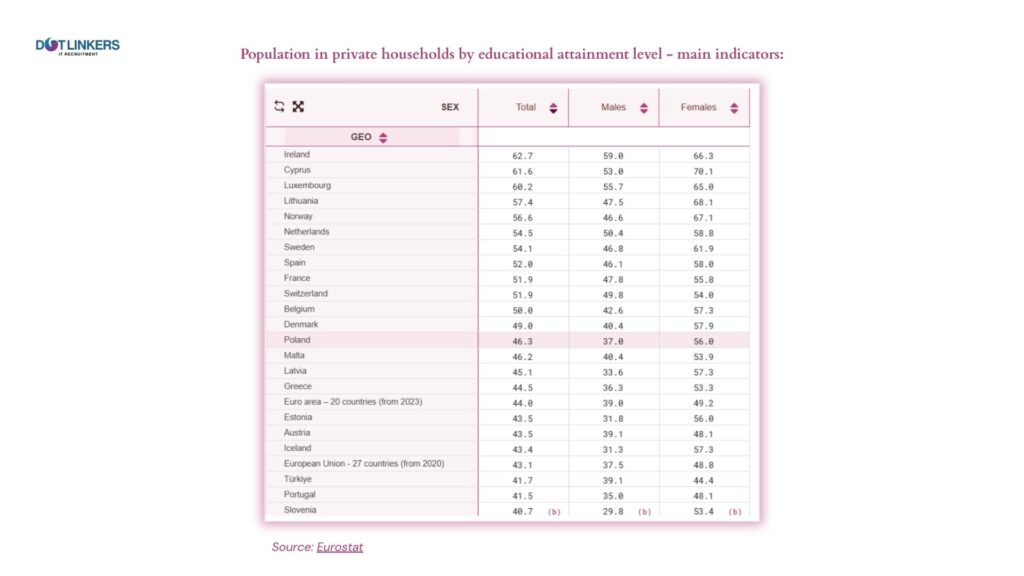
Poland has a strong educational system, particularly in technical and scientific fields. Many universities offer high-level IT and engineering programs, producing a steady stream of well-qualified professionals. Polish IT specialists are highly valued for their analytical thinking, problem-solving abilities, and creativity (skills that are continually honed by a rigorous academic background). Approximately 46.3% of young adults in Poland (aged 25–34) hold a tertiary education degree, which is above the EU average (43%) and significantly higher than the United States (around 41%), according to data from Eurostat and the OECD. Moreover, Poland has one of the highest participation rates in STEM education among EU countries, with thousands of students graduating annually in fields such as computer science, mathematics, and engineering. This strong academic foundation directly translates into a highly competent workforce, making Poland an attractive destination for global tech companies seeking top-tier technical talent.
Large Pool of Qualified IT Specialists
Poland is home to one of the largest and most mature IT talent pools in Europe. As of 2024, the number of professionals working in the broader information and communication technologies (ICT) sector exceeds 525,000, with over 295,000 actively employed software developers, making Poland a clear leader in the Central and Eastern European region. According to the Polish Investment and Trade Agency (PAIH), the number of qualified IT professionals in Poland continues to grow steadily each year, supported by a strong academic foundation and robust demand from international companies. Each year, Polish universities and technical institutes graduate more than 75,000 students in ICT-related fields, including computer science, automation, telecommunications, and applied mathematics.
This consistent influx of new talent ensures long-term scalability for companies establishing or expanding operations in Poland. The country’s largest urban centers, including Warsaw, Krakow, Wroclaw, Gdansk, Poznan, and Katowice, have developed into dynamic tech ecosystems with a concentration of R&D centers, software houses, and product companies. These cities offer not only access to skilled professionals but also mature infrastructure, innovation hubs, and growing startup communities.
Attractive Cost-to-Quality Ratio
One of Poland’s most compelling advantages as a tech destination lies in its attractive cost-to-quality ratio. Employment costs in the country are considerably lower than in Western Europe or the U.S., yet the quality of IT services remains at a world-class level. This combination makes Poland particularly appealing for international companies aiming to build or expand their development teams, shared service centers, or R&D units while maintaining cost efficiency and technical excellence. IT professionals in Poland earn competitive salaries relative to local standards, but still represent a more affordable option compared to their counterparts in Western economies. The average monthly gross salary for mid-level software engineers in Poland ranges from €3,500 to €4,700, while senior developers may earn from €6,000 to €8,000. In comparison, similar roles in Germany, the Netherlands, or the US can cost employers up to twice as much.
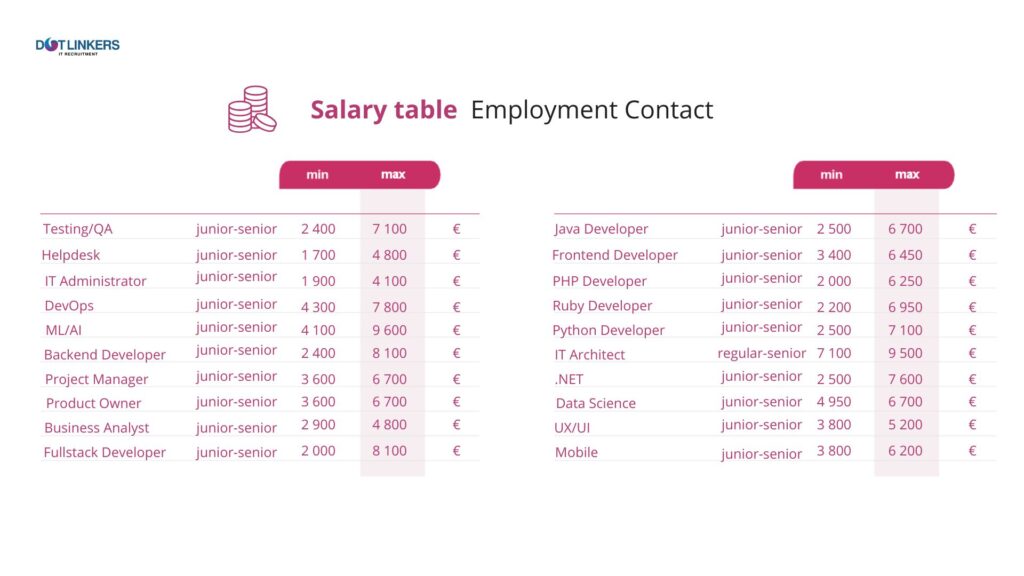
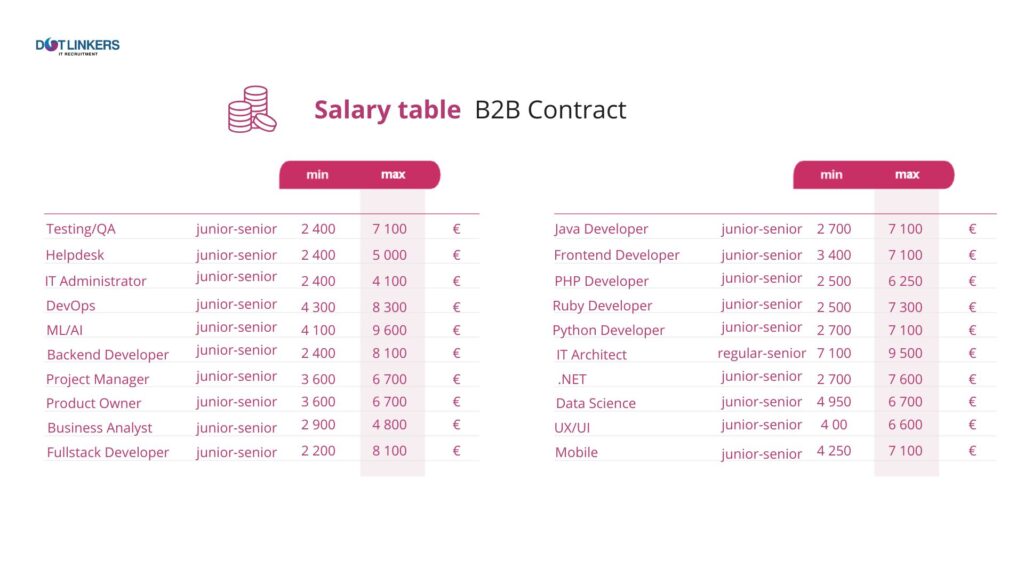
At the same time, Poland maintains a relatively moderate cost of living, which enables employees to enjoy a high standard of living without requiring the same salary levels as in more expensive countries.
Another factor that contributes significantly to Poland’s labor cost efficiency is the widespread use of contracts among IT professionals. A large portion of Polish developers, particularly those with more experience, choose to work under a self-employed model. This arrangement allows for greater flexibility, both for companies and employees, while also reducing the administrative and tax burden on the employer’s side. Importantly, B2B employees in Poland are typically treated the same as full-time employees in terms of integration, team collaboration, access to company benefits, and professional development. From an operational perspective, this model enables organizations to reduce employment-related overhead by as much as 25% to 30% while still attracting and retaining top-tier talent.
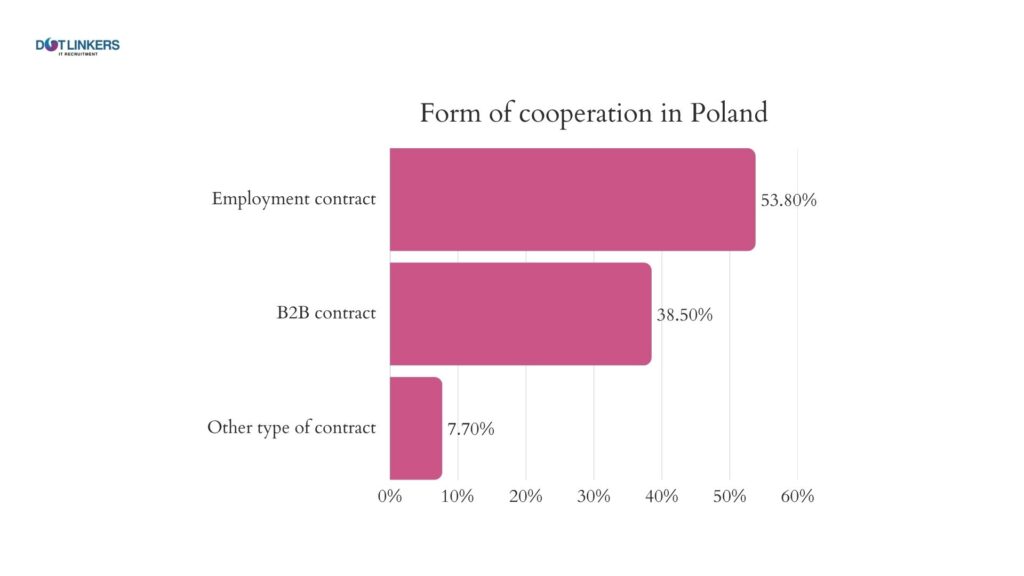
Additionally, current market data shows that 53.8% of IT professionals in Poland work under a traditional UoP (employment contract), while 38.5% operate on B2B contracts, and the remaining 7.7% are employed via other types of agreements. This distribution indicates that, although B2B remains a very strong model, the majority of the workforce still relies on the stability and protections offered by UoP. Such a balanced mix reinforces Poland’s ability to offer both cost-efficient and secure employment frameworks.
Beyond salaries and employment models, the overall cost of doing business in Poland also plays a role in enhancing its competitiveness. Office rental prices in major Polish tech cities such as Krakow, Wroclaw, and Gdansk are significantly lower than those in London, Berlin, or Amsterdam. Legal and administrative services are widely available and competitively priced, and the government continues to develop supportive policies aimed at fostering innovation, research and development, and digital transformation.
Access to Modern Infrastructure and Technologies
Poland is rapidly developing its technological infrastructure, with broad access to cloud computing, big data, and AI platforms. Major providers like Microsoft, Google, and AWS have established data centers in the country, and Microsoft recently announced a PLN 2.8 billion investment to expand its cloud and AI operations. The AI ecosystem is highly competitive, supported by over 50,000 skilled AI and data professionals, making Poland a top nation in programming and data science talent. Demand for AI specialists is growing rapidly, with hundreds of new AI/ML roles and over 10% of IT job listings explicitly referring to AI or generative technologies in 2024.
Poland is also home to some of the world’s most influential AI innovators. Wojciech Zaremba, co-founder of OpenAI, has been instrumental in developing groundbreaking models such as GPT and advancing robotics research. A graduate of the University of Warsaw and New York University, Zaremba has contributed to some of the most significant breakthroughs in deep learning, reinforcement learning, and natural language processing. He played a key role in shaping OpenAI’s research strategy, helping to bridge cutting-edge AI theory with practical applications that now impact millions of users worldwide. Beyond his technical contributions, Zaremba is also known for mentoring young AI researchers and fostering the growth of the AI community in Poland and globally.
Another notable success story is ElevenLabs, founded by Polish entrepreneurs and now recognized globally for its AI-powered voice technology used by millions of creators and enterprises. The company has pioneered lifelike speech synthesis that allows content creators, game developers, and broadcasters to generate realistic voices with minimal input.
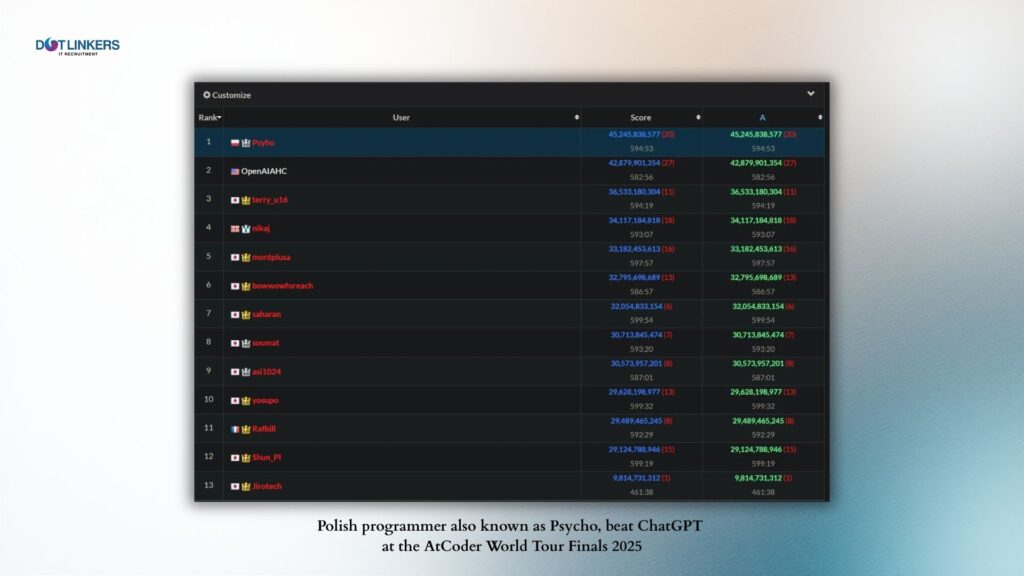
Demonstrating the exceptional skill of local talent, in an unprecedented man-versus-AI showdown, Polish programmer Przemysław Dębiak, known as Psycho, defeated an advanced OpenAI model in a 10-hour programming marathon during the AtCoder World Tour Finals 2025 in Tokyo. The competition gathered 12 of the world’s top programmers, and the man-versus-AI face-off drew exceptional attention, with OpenAI entering its own model as an official participant. Beyond the technical victory, Psycho’s achievement showcased innovative problem-solving strategies and creative algorithmic thinking that went beyond what current AI models could achieve, highlighting Poland’s capacity to produce world-class AI talent.
Strong Foreign Language Skills, Especially English
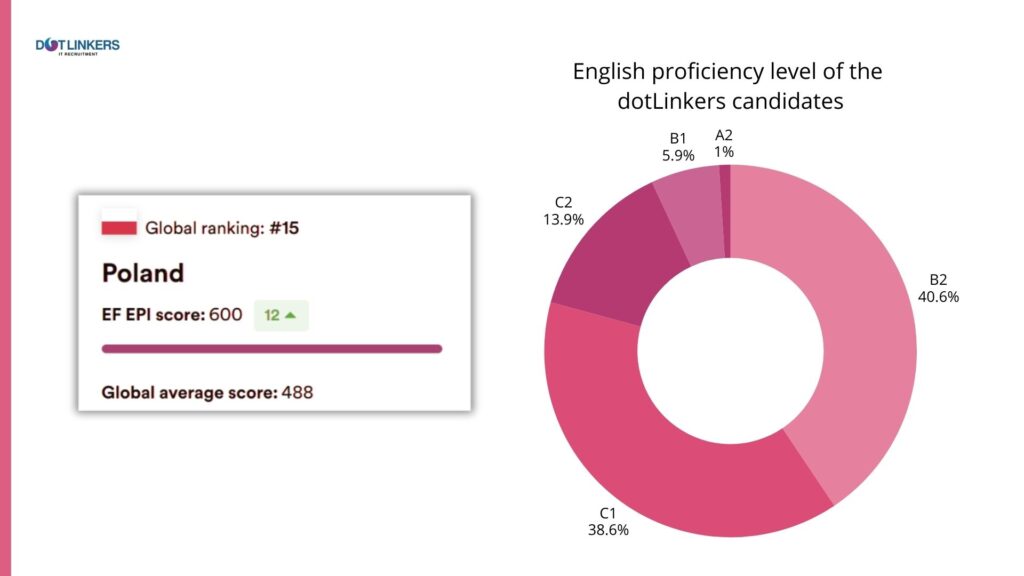
Polish professionals have a high level of English proficiency, which greatly facilitates collaboration with international clients and teams. English is widely used in the IT industry, offering a significant advantage over other countries where language barriers can be more pronounced. According to the EF English Proficiency Index, Poland consistently ranks among the top non-native English-speaking countries in the world, with IT professionals often demonstrating near-native fluency. Currently, Poland holds 15th place in Europe according to the same index. English is the standard language of instruction in many technical university programs and IT training courses, which ensures that graduates are well-prepared to work in global environments. In addition to English, many specialists also have knowledge of other foreign languages, such as German, French, or Spanish, further enhancing the potential for multilingual cooperation.
When looking specifically at IT candidates, our internal data shows a consistently high level of English proficiency across our talent pool, which consists of over 16,000 candidates. As many as 46.6% speak English at a B2 level, 38.6% at C1, and 13.9% at C2, while lower levels are rare (B1 – 5.9%, A2 – 1%).
Moreover, Poland’s geographic location creates a favorable time zone difference for companies based in North America. While U.S. teams are offline, Polish developers can continue progressing with tasks, ensuring near-continuous workflow and faster project delivery. At the same time, the time zones partially overlap (particularly with the U.S. East Coast), allowing for several hours of real-time communication during the standard business day. This alignment enables daily stand-ups, live meetings, and smooth coordination, striking an optimal balance between productivity and collaboration in distributed teams.
Women in the Polish IT Industry
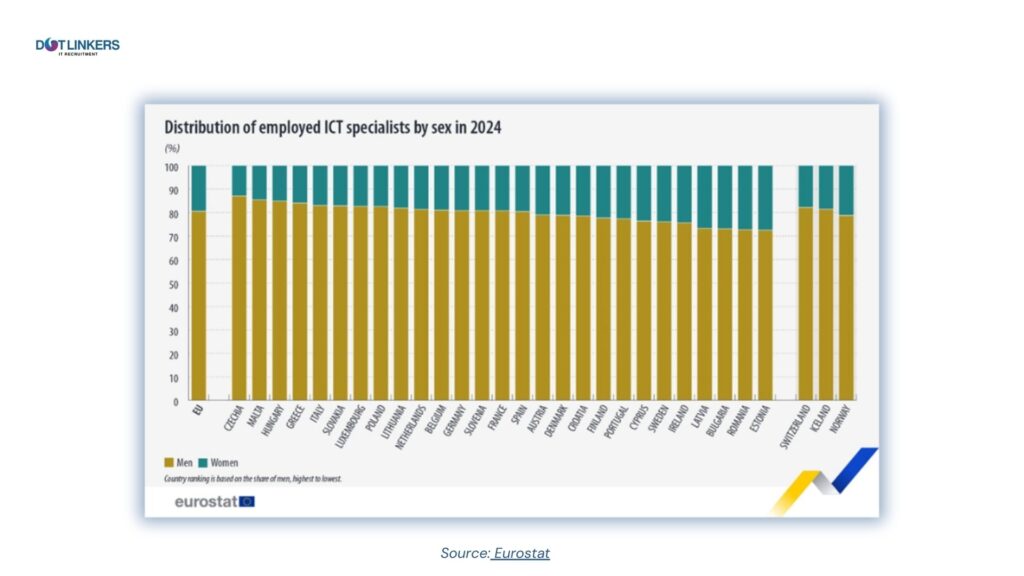
An important feature of the Polish technology sector is the growing participation and visibility of women in IT-related professions. Although the industry remains male-dominated globally, Poland has seen a steady increase in the share of women working in technology, supported by numerous educational and professional initiatives. According to the Polish IT Community Report 2025 by Bulldogjob, women currently represent approximately 19.7% of the IT workforce in Poland. Other studies, such as the Eurostat ICT Specialist Report, indicate that in 2024 women accounted for approximately 17.5% of all ICT specialists in Poland, placing the country slightly below the EU average of around 19.5%. In a broader context, including research and technology sectors, the representation of women is significantly higher-data from 2024 show that in three major Polish macroregions, women make up over 62% of employees in science and technology-related fields.
Despite these positive trends, the structure of employment within the IT industry reveals that women are still underrepresented in highly technical and engineering roles, such as software development or DevOps. They are more frequently found in positions related to quality assurance, UX/UI design, or project management. This pattern, however, is gradually changing as more women pursue technical education and transition into programming and infrastructure roles. Polish universities and technology schools have noted an upward trend in female students choosing STEM disciplines, and many IT companies in Poland now promote programs that actively encourage women to pursue technical careers.
Poland hosts a number of initiatives supporting women in technology. Programs like the Perspektywy Women in Tech Summit, IT for SHE, and the Women in Technology Poland community provide mentoring, workshops, and networking opportunities for female IT professionals. These initiatives help increase female participation in tech and strengthen their presence in the Polish IT sector. They create opportunities for skill development and career growth, while also fostering a supportive community for women in IT. Together, these programs help close the gender gap and encourage more women to enter and thrive in the technology sector.
Rapidly Growing Job Market and Career Opportunities
The IT sector in Poland is one of the fastest-growing industries. With an increasing number of startups, international companies, and tech investments, IT professionals have access to dynamic career paths, opportunities to learn new skills, and clear prospects for advancement. The demand for specialists in areas such as cloud computing, cybersecurity, data science, and artificial intelligence is rising steadily, creating a wide range of specialized roles. Many companies offer structured development programs, certifications, and mentorship opportunities to support continuous learning. Additionally, the remote and hybrid work culture further expands job flexibility, allowing Polish IT professionals to work for top global firms without relocating. A part from the largest tech corporations, Poland has also attracted key international players like Capgemini, Accenture, EPAM Systems, Luxoft, SoftServe, and Cognizant, which have opened technology and delivery centers in cities such as Krakow, Wroclaw, and Lodz. These organizations are involved in complex global projects in fintech, healthcare, automotive, and telecommunications, offering Polish specialists the chance to work on world-class technologies.
On the startup scene, Poland is home to ambitious and fast-growing ventures such as Brainly (a globally used edtech platform), Zowie (AI-powered customer support), Synerise (AI/analytics for business), and Booksy (a global beauty & wellness booking app). The local ecosystem is also strengthened by rising stars like Eleven Labs (AI voice technology), DocPlanner (healthtech platform), Klarna (with a growing presence in Poland), and Brand24 (media monitoring and analytics).
Proximity to Western Markets
Poland’s location at the heart of Europe offers IT companies excellent connectivity and seamless access to key Western European markets, such as Germany and the UK, enabling efficient cooperation and faster decision-making. Sharing similar time zones allows IT teams in Poland to collaborate in real-time with their counterparts abroad, facilitating agile workflows, timely project updates, and smoother communication across global development cycles. Additionally, Poland’s alignment with EU regulatory standards ensures that IT services and software solutions developed here meet the compliance requirements expected by Western clients, simplifying integration and fostering trust in cross-border partnerships.
