




As businesses continue to expand globally, hiring talent across borders has become a strategic priority. Whether you’re a startup entering new markets, a scale-up building distributed teams, or an enterprise seeking specialized expertise, accessing the best talent is no longer limited by geography. However, international hiring comes with legal, tax, payroll, and compliance challenges. Setting up a local subsidiary in every country where you want to hire is often expensive, time-consuming, and unnecessary. This is where an Employer of Record (EOR) becomes a valuable solution. In this guide, you’ll learn what an Employer of Record is, how EOR services work, their key benefits, and when they are the right choice for your business.
Key points from the article:
- An Employer of Record (EOR) acts as the official legal employer for international workers, managing payroll, taxes, benefits, and labor compliance while the client company retains control over day-to-day work administration.
- Utilizing an Employer of Record enables organizations to scale global remote teams and enter new markets within days or weeks without the high cost and time required to establish local legal subsidiaries.
- The primary distinction between an EOR and a Professional Employer Organization (PEO) is that an EOR serves as the sole legal employer, whereas a PEO operates under a co-employment model that requires the client company to have an established local entity.
- Implementing an EOR solution minimizes international expansion risks by legally transferring the responsibilities of evolving local labor laws and regulatory compliance to a specialized third-party provider.
Table of Contents
What Is an Employer of Record (EOR)?
An Employer of Record (EOR) is a third-party organization that legally employs workers on behalf of another company. While the employee performs day-to-day work exclusively for your business, the EOR becomes the official legal employer and assumes responsibility for all employment-related administrative and legal obligations.
An Employer of Record typically manages:
- Employment contracts
- Payroll administration
- Tax withholding and reporting
- Social security contributions
- Employee benefits
- Labor law compliance
- HR administration
- Employee onboarding and offboarding
This enables businesses to hire internationally without opening a legal entity in the employee’s country.

How Does an Employer of Record Work?
Working with an EOR follows a straightforward process.
- YouFind the Right Candidate
Your company recruits the employee independently or works with a recruitment partner to identify the ideal candidate.
- The EORBecomesthe Legal Employer
The Employer of Record prepares a locally compliant employment contract and officially hires the employee.
- The EORHandlesEmployment Administration
The EOR manages all employment-related responsibilities, including:
- Payroll processing
- Income tax calculations
- Social contributions
- Employee benefits
- HR documentation
- Labor law compliance
- YouManage the Employee
Although the EOR is the legal employer, your company directs the employee’s daily responsibilities, performance, projects, and career development.
What Do Employer of Record Services Include?
Professional Employer of Record services provide far more than payroll administration.
A comprehensive EOR solution typically includes:
- Local employment contracts
- Payroll management
- Tax administration
- Benefits administration
- Employment compliance
- HR support
- Employee onboarding
- Offboarding assistance
- Leave management
- Ongoing legal and HR advisory
By outsourcing these responsibilities to an experienced EOR provider, businesses reduce administrative workload while ensuring compliance with local employment regulations.
Employer of Record in Poland
Poland has become one of Europe’s leading destinations for technology talent, engineering expertise, and business services. Many international companies choose an Employer of Record in Poland to hire employees quickly without establishing a Polish legal entity.
An EOR solution is particularly valuable for:
- Technology companies
- SaaS businesses
- Startups expanding into Central Europe
- Global organizations building remote teams
- Companies testing the Polish market before opening an office
Using an Employer of Record significantly reduces the complexity and cost of entering the Polish market.
When Should You Use an Employer of Record?
An Employer of Record is an ideal solution if your company:
- Wants to hire employees in countries where it has no legal entity
- Is expanding into international markets
- Needs to hire remote employees globally
- Wants to reduce legal and compliance risks
- Needs to hire quickly without company registration
- Is testing a new market before making long-term investments
For many organizations, an EOR serves as a practical bridge before establishing a local subsidiary.
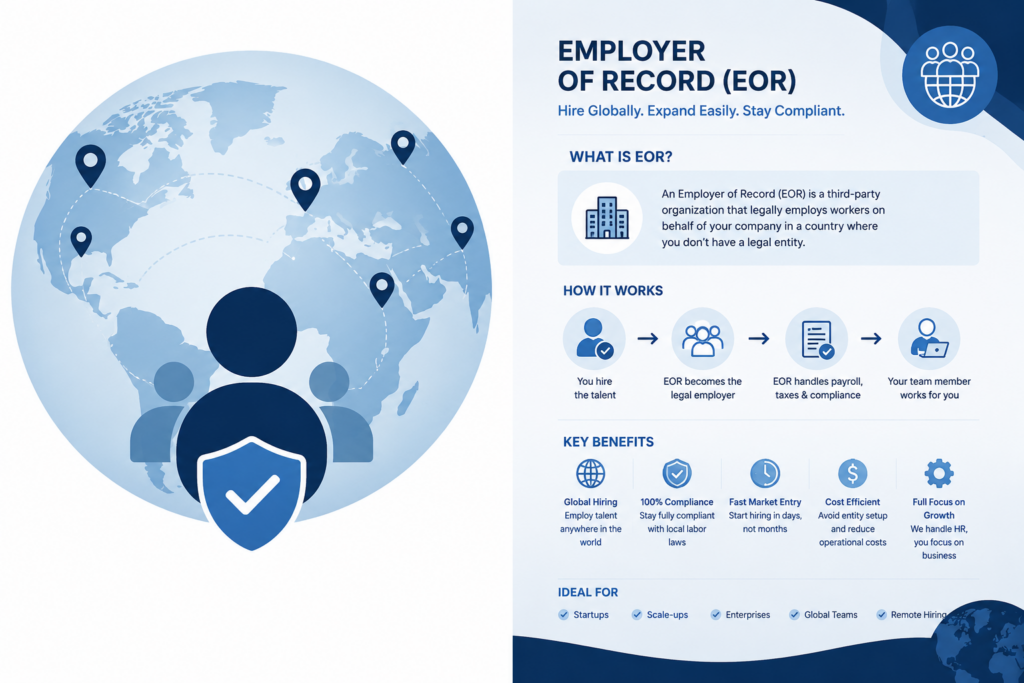
What are the Benefits of Employer of Record Services?
Faster International Expansion
Instead of waiting months to establish a foreign entity, businesses can begin hiring within days or weeks.
Lower Administrative Costs
Using an EOR eliminates the need to:
- Register a local company
- Build internal HR infrastructure
- Hire local legal advisors
- Manage complex payroll systems
Full Compliance
Employment laws vary significantly between countries. An experienced Employer of Record ensures compliance with local labor regulations, tax requirements, and employment standards.
Reduced Legal Risk
The EOR assumes responsibility for employment compliance, reducing the risk of costly legal or regulatory issues.
Greater Flexibility
Businesses can scale international teams up or down without the long-term commitment of maintaining legal entities in multiple countries.
Employer of Record vs. Professional Employer Organization (PEO)
Although the terms Employer of Record (EOR) and Professional Employer Organization (PEO) are sometimes used interchangeably, they represent two distinct employment models. The key difference is that an Employer of Record becomes the employee’s legal employer. This allows companies to hire workers in countries where they do not have a registered legal entity. The EOR assumes responsibility for employment contracts, payroll, taxes, benefits, and compliance with local labor laws. A Professional Employer Organization (PEO), on the other hand, operates under a co-employment model. The client company remains the legal employer and must already have a registered business entity in the country where employees are hired. The PEO supports HR administration, payroll, employee benefits, and other HR functions but does not replace the employer of record.
In practice, an Employer of Record is the preferred solution for international expansion and global hiring, while a PEO is best suited for companies that already have an established presence in a specific country and need additional HR support.
Employer of Record vs. Staffing Agency
An Employer of Record should not be confused with a staffing or recruitment agency.
A recruitment agency focuses on sourcing and introducing candidates.
An Employer of Record, however:
- Legally employs the worker
- Handles payroll and tax compliance
- Manages employment administration
- Ensures compliance with local employment laws
Many companies combine recruitment services with EOR solutions to both find and legally employ international talent.
How to Choose the Right Employer of Record Provider?
Selecting the right EOR partner is essential for long-term success.
When evaluating providers, consider:
- International experience
- Coverage across multiple countries
- Expertise in local labor laws
- Transparent pricing
- Payroll capabilities
- HR and legal support
- Data security standards
- Customer support quality
A reliable Employer of Record should function as an extension of your HR team rather than simply acting as a payroll provider.
Is Employer of Record Legal?
Yes. Employer of Record services are a fully legal and widely adopted employment model used by thousands of multinational companies worldwide. The key is choosing an experienced EOR provider that complies with local employment legislation, tax regulations, and labor laws in every country where employees are hired. Working with a trusted partner helps minimize compliance risks while enabling rapid international hiring.
An Employer of Record (EOR) is one of the most efficient ways for businesses to hire employees internationally without establishing local legal entities. By managing employment contracts, payroll, taxes, compliance, and HR administration, an Employer of Record enables organizations to expand globally while minimizing legal risks and administrative complexity. Whether you’re entering new markets, building remote teams, or hiring specialists in Poland or elsewhere, Employer of Record services provide a flexible, compliant, and scalable solution for international workforce management.
