




In the fast-paced world of IT, where technological change often outpaces traditional hiring processes, companies are increasingly turning to embedded recruitment. This approach involves integrating a recruiter directly into the technical team, making them a true extension of the organization. As a result, they gain a deeper understanding of business needs, team culture, and the real requirements behind each role. Instead of functioning as an external service, recruitment becomes a strategic partner to the business—enabling faster hiring, better candidate fit, and improved alignment between talent and company goals.
In this guide, we’ll explore how embedded recruitment works in IT, when it makes sense to implement it, and the key benefits it can bring to tech organizations.
Key points from the article:
- Embedded recruitment integrates external talent experts directly into a company’s internal teams to act as a seamless extension of the organization.
- The embedded model operates on a scalable subscription or retainer basis, providing a more predictable cost structure than traditional commission-based recruitment.
- Recruiters in an embedded model utilize the client’s internal systems and branding to improve candidate experience and cultural alignment.
- This strategic approach utilizes a data-driven methodology to optimize recruitment processes, reducing the overall time-to-hire for technical roles.
- Embedded recruitment is specifically designed for high-growth tech companies that require rapid scalability and a proactive talent pipeline.
What is Embedded Recruitment and how does it work?
Table of Contents
Embedded Recruitment is a model in which external recruiters are integrated into a client’s internal talent acquisition team, acting as its full-fledged part for a defined period of time.
In practice, this means that:
- the recruiter works in the client’s systems (ATS, CRM, communication tools),
- participates in team meetings and decision-making processes,
- collaborates directly with hiring managers,
- operates based on the organization’s business goals rather than purely project KPIs.
A key element of this model is integration and shared accountability. An embedded recruiter does not only deliver candidates, but they also co-create the hiring strategy and take responsibility for its execution. This model is also referred to as Recruitment-as-a-Service (RaaS) and represents a hybrid of in-house recruitment, agency recruitment, and outsourcing.
Key characteristics of Embedded Recruitment
Embedded Recruitment has a set of characteristics that define its effectiveness. The first is full integration with the client’s organization. Recruiters operate as part of the team, often adopting the company’s branding and representing it in communication with candidates and stakeholders. The second is dedication and focus. Unlike agencies working on multiple clients simultaneously, an embedded recruiter focuses exclusively on one organization and its business goals. The third important feature is a data-driven approach. Recruitment processes are continuously measured, analyzed, and optimized, which increases efficiency and predictability of outcomes. Finally, Embedded Recruitment is highly scalable – teams can be expanded or reduced dynamically depending on business needs.
Embedded Recruitment process – step by step
The Embedded Recruitment process is significantly more advanced than traditional recruitment models because it is not limited to individual hiring requests. It is continuous, iterative, and strategic, closely aligned with business objectives.
1.Onboardingand full integration with the organization
The first stage is a comprehensive onboarding of the recruitment team. This goes far beyond gaining access to tools such as ATS, CRM, or communication platforms. It involves deep immersion in the client’s organization.
The embedded recruiter gains understanding of:
- organizational structure and teams,
- technology stack,
- company culture and values,
- decision-making style,
- expectations toward candidates.
At this stage, building strong relationships with hiring managers and business stakeholders is crucial.
2.Needsanalysis and talent audit
The next step is a detailed analysis of hiring needs, often in the form of a talent audit.
It includes:
- analysis of current and future hiring needs,
- evaluation of existing recruitment processes,
- identification of bottlenecks (e.g. long time-to-hire),
- assessment of market competitiveness of job offers,
- review of candidate experience.
At this stage, recruitment shifts from an operational function to a business strategy component.
3.Buildingthe recruitment strategy
Based on gathered insights, a tailored recruitment strategy is created. It is not a template but a customized operating model.
The strategy includes:
- definition of candidate personas,
- selection of sourcing channels,
- candidate communication plan,
- KPIs and success metrics (e.g. time-to-hire, quality-of-hire),
- employer branding approach.
Hiring priorities and a recruitment roadmap for the upcoming months are also defined.
4.Proactivesourcing and pipeline building
Unlike traditional models, Embedded Recruitment relies on continuous and proactive sourcing.
Recruiters:
- actively reach out to passive candidates,
- build long-term relationships,
- develop talent pipelines,
- segment candidates based on skills and fit.
The pipeline is not a static database, it is a living talent ecosystem that significantly reduces future hiring time.
5.Processmanagement and collaboration with hiring managers
The embedded recruiter acts as a bridge between the business and candidates, ensuring process efficiency and quality.
Key responsibilities include:
- conducting screenings and interviews,
- coordinating recruitment stages,
- advising hiring managers,
- optimizing decision-making processes,
- ensuring a positive candidate experience.
Close collaboration with hiring managers enables faster decisions and reduces the risk of poor hires.
6.Reporting and data-drivenapproach
Embedded Recruitment is strongly rooted in data. Regular reporting allows continuous monitoring of performance.
Key metrics include:
- time-to-hire,
- conversion rates across stages,
- candidate sources,
- quality of hires.
This enables decisions based on data rather than intuition.
7.Optimizationand continuous improvement
One of the most important aspects of Embedded Recruitment is its continuous nature. The process does not end when a candidate is hired, this is only the starting point for further optimization.
Activities include:
- improving recruitment processes,
- shortening decision-making paths,
- enhancing candidate experience,
- adapting strategy to market changes.
In practice, recruitment becomes a system that learns and evolves with the organization.
8.Scalingand adaptation to business needs
The final but crucial element is scalability. Embedded Recruitment allows organizations to flexibly adjust recruitment capacity to current needs. This is especially important in the IT industry, where talent demand can change very rapidly.
What does Embedded Recruitment include?
Embedded Recruitment is an end-to-end model that covers both operational and strategic activities. The scope of responsibilities may include:
- talent sourcing and headhunting,
- managing end-to-end recruitment processes,
- candidate communication management,
- employer branding development,
- data analysis and reporting,
- designing and optimizing recruitment processes.
In more advanced implementations, an embedded partner can also build entire Talent Acquisition functions from scratch, including processes, tools, and organizational structures.
Embedded Recruitment vs traditional recruitment and RPO – key differences
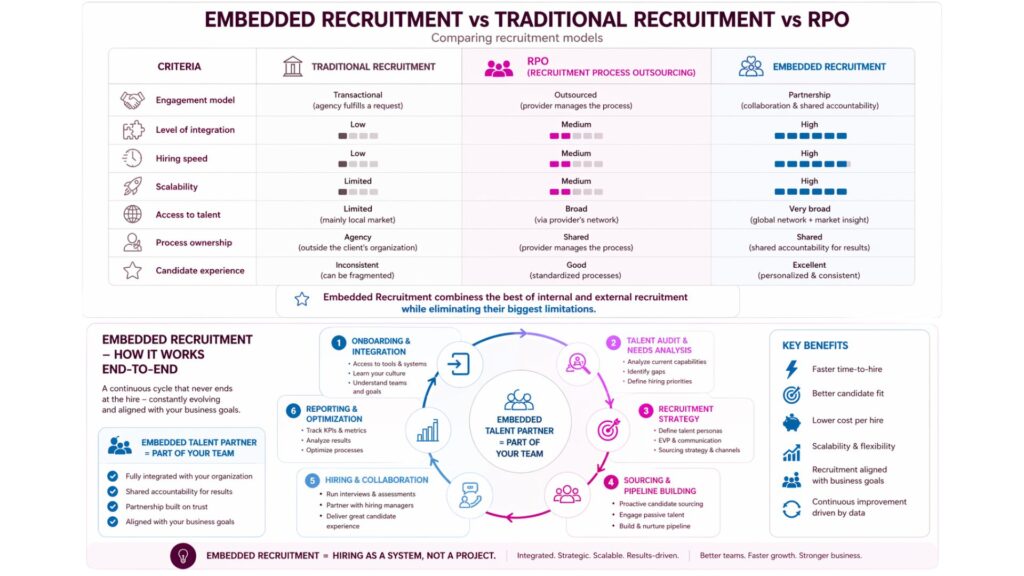
Traditional recruitment (Success Fee) is primarily based on a transactional model, where a recruitment agency acts as an external service provider responding to a specific, one-off hiring need from a client. In this approach, the relationship is short-term, and the level of organizational integration is limited. The recruiter understands the role requirements but often lacks full visibility into company culture, team dynamics, or long-term business strategy. As a result, the recruitment process tends to be more reactive than strategic, and candidate matching focuses mainly on hard criteria such as experience and technical skills.
Embedded Recruitment represents a fundamentally different approach, based on a relational and strategic model. Recruiters act as an integral part of the organization, which means full immersion in its structure, processes, and decision-making mechanisms. This enables a much deeper understanding of the business context, which directly translates into better candidate matching; not only in terms of skills but also cultural fit and long-term potential. Additionally, close collaboration with hiring managers enables faster decision-making, reduced delays, and greater control over the entire recruitment lifecycle. In practice, Embedded Recruitment combines the advantages of in-house and external recruitment while eliminating their typical limitations – such as lack of scalability in internal teams or lack of deep context in agency models.
In this context, it is also worth comparing Embedded Recruitment with the RPO (Recruitment Process Outsourcing) model, which involves outsourcing all or part of recruitment processes to an external provider operating based on predefined structures, procedures, and KPIs. RPO is usually more formalized and operational; it focuses on delivering specific performance metrics, often within clearly defined SLAs, which may limit flexibility in highly dynamic environments such as the IT industry. Embedded Recruitment differs from RPO primarily in the level of integration with the organization, which is significantly higher and more organic, as well as in its collaborative approach, which is partnership-based rather than strictly outsourcing-oriented. The embedded model is more flexible, allows faster response to business changes, and better adapts to the needs of product or engineering teams. For this reason, it is often described as a more “human-centric” approach that works particularly well in fast-paced environments such as technology companies, startups, and scale-ups, where speed, quality of hiring, and scalability are critical.
What are advantages and disadvantages of the Embedded Recruitment model?
Embedded Recruitment is gaining importance primarily because it addresses the real limitations of traditional recruitment approaches in the IT environment. Its value does not come only from operational efficiency but from a fundamental shift in thinking about talent acquisition, from a reactive “candidate delivery” process to a continuous, strategic system for building teams. One of the most important advantages of Embedded Recruitment is increased hiring efficiency. This results from the fact that recruiters are fully integrated into the organization, which shortens communication paths, reduces the number of intermediaries, and enables faster decision-making. In practice, this translates into shorter time-to-hire and a smoother recruitment process where information is not lost between different stakeholders.
Another key benefit is better candidate fit with organizational culture. Due to deep immersion in the company structure, an embedded recruiter does not rely solely on job descriptions but understands team dynamics, management style, and company values. This ensures that candidate evaluation considers not only technical skills but also cultural fit and long-term collaboration potential. A further advantage is cost reduction compared to commission-based models. In the embedded model, costs are typically more predictable and based on a retainer or subscription structure, which allows for better budget planning and avoids high one-off success fees. Another important benefit is the ability to scale recruitment teams depending on business needs. Organizations can dynamically increase or decrease recruiter involvement depending on growth phase, number of open roles, or market conditions. This makes the model particularly attractive for technology companies operating in highly volatile and fast-scaling environments.
At the same time, Embedded Recruitment is not without limitations. One of the key challenges is the need for active organizational involvement in the process. Unlike traditional outsourcing, this model requires close collaboration, regular communication, and availability of decision-makers. Without this level of engagement, it is difficult to fully realize its potential. Another limitation is lower cost efficiency in low-volume hiring scenarios. Embedded Recruitment works best in organizations running multiple parallel hiring processes or planning rapid growth. For occasional, single hires, its cost structure may be less efficient than traditional project-based recruitment. The third important aspect is the need for process maturity on the client side. For the model to work effectively, the organization should have at least a basic decision-making structure, clearly defined hiring roles, and readiness to work in a data- and process-driven way. In organizations with very low maturity, implementation may require additional time and support in building foundational recruitment processes.
In summary, Embedded Recruitment is a highly effective and strategically valuable model, but its success largely depends on the quality of collaboration between the organization and the recruitment partner, as well as the company’s readiness to operate in a more integrated, partnership-based hiring model.
Why Embedded Recruitment is becoming the standard in tech companies
Modern technology companies operate in conditions that can be described as permanent volatility, both in terms of the labor market and product development or business models. The rapid growth of startups, the expansion of scale-ups, and global competition for talent mean that organizations need recruitment models that not only respond to current needs but are also capable of real-time adaptation. In this context, Embedded Recruitment is becoming a natural response to the limitations of traditional talent acquisition structures.
One of the key reasons for its growing popularity is its ability to scale recruitment teams quickly alongside organizational growth. Unlike classic in-house models, where expanding the HR department requires time, budget, and recruitment processes for HR itself, Embedded Recruitment allows companies to flexibly increase or decrease recruitment capacity depending on current business needs. This means that organizations can go through intense growth phases without creating hiring bottlenecks.
Another important factor is access to global talent markets. Embedded recruiters, working within specialized agencies, often have extensive international experience and well-developed networks, enabling them to reach passive candidates who are not available through traditional recruitment channels. In the IT industry, where skill shortages are particularly severe, this becomes a key factor in maintaining competitiveness. The third pillar is the integration of recruitment with business objectives. Embedded Recruitment does not function as an isolated HR process but as part of the company’s growth strategy. This means that hiring decisions are directly linked to the product roadmap, sales goals, or market expansion plans. In practice, this leads to better alignment between hires and actual business needs, rather than simply reacting to vacancies. As a result, Embedded Recruitment is particularly attractive to startups, scale-ups, and organizations in high-growth phases, where not only the number of hires matters, but above all the speed, quality, and predictability of the entire team-building process.
When is it worth implementing Embedded Recruitment?
The decision to implement Embedded Recruitment most often arises when an organization begins to experience the limitations of its existing recruitment model. It is not a universal solution for every company and every stage of development, but its effectiveness increases significantly under specific business conditions. First and foremost, it is particularly recommended in situations of rapid organizational growth, when the number of open roles increases faster than the capacity of the internal HR or Talent Acquisition team. In such cases, traditional structures are often unable to provide sufficient process throughput, leading to hiring delays and loss of candidates to competitors. Another key scenario is a high volume of parallel recruitment processes, especially in technology environments where companies are simultaneously hiring for a wide range of roles, from software engineers and DevOps specialists to product and data positions. Embedded Recruitment enables effective management of such a complex talent pipeline without sacrificing process quality.
This model is also well-suited for organizations with limited internal HR or Talent Acquisition resources. This may result either from a shortage of recruiters or from insufficient experience in IT recruitment. In such cases, Embedded Recruitment acts as an extension of the internal team, bringing both market knowledge and operational expertise. A fourth key use case is the need to optimize hiring processes. This applies especially to companies that, despite ongoing recruitment efforts, are not achieving satisfactory results in terms of time-to-hire, candidate quality, or conversion rates at different stages of the process. Embedded Recruitment enables deep analysis and redesign of these processes based on data and market best practices.
Finally, the model is particularly useful during periods of organizational transformation, such as entering new markets, changing business models, or rapid product expansion. In such situations, it is often necessary not only to quickly hire new employees but also to build or restructure the entire Talent Acquisition function. Embedded Recruitment enables this process in a structured, scalable, and strategically aligned way.
What can you expect from an embedded talent partner?
An embedded talent partner is far more than a traditional agency recruiter. Their role is multidimensional, combining operational, strategic, and organizational support, which makes them a true extension of the internal Talent Acquisition team. On the operational level, an embedded talent partner is responsible for managing end-to-end recruitment processes—from sourcing candidates and conducting screenings to coordinating interviews and closing hires. The goal is not only to “fill roles” but to ensure process continuity, quality, and a high standard of candidate experience. On the strategic level, their role expands into advising the labor market, talent availability, and optimal sourcing strategies. The embedded partner brings market intelligence, salary benchmarks, competitive insights, and recommendations on team structure. This enables the organization to make more informed hiring decisions that are better aligned with business realities.
On the organizational level, the embedded talent partner contributes to building or optimizing the Talent Acquisition function itself—defining processes, designing tools, and improving collaboration between teams. In practice, this means influencing not only individual hiring processes but also how the organization manages talent as a whole. As a result, the embedded talent partner does not operate as an external service provider but as a co-responsible business partner actively contributing to hiring success and organizational growth.

A model designed to solve the biggest hiring challenges
Embedded Recruitment represents a significant evolution in the way recruitment is approached, particularly in the technology sector, where the pace of change and competition for talent are exceptionally high. This model combines operational efficiency with a strategic mindset, creating a system that supports organizations not only in hiring employees but also in building long-term competitive advantage. Its strength lies in the fact that it has been designed as a response to the most important and systemic challenges of modern hiring: talent shortages, increasing time-to-hire, poor candidate fit, and the lack of scalability in traditional recruitment processes. Thanks to integration with the organization, a flexible cooperation model, and a data-driven approach, Embedded Recruitment enables companies not only to compete more effectively for talent but also to build more stable and predictable growth structures.
In practice, this means that recruitment ceases to be merely an operational function and becomes a core part of business strategy, directly influencing the pace of organizational growth and its ability to scale in a dynamic IT market environment. From this perspective, Embedded Recruitment is no longer just an alternative to traditional models; it becomes their natural evolution and is increasingly becoming the standard in modern technology organizations.
